
Scout’s blog has no shortage of case studies with impressive metrics: a 90% drop in mean response time, 2x performance gains, 3x faster responses. Easy setup and fast time-to-value come up again and again. This time, we’re looking at how BackerKit made the switch from Datadog to Scout, how it’s changed the routine and improved productivity inside their team, and some ways they’re exploring Scout MCP.
BackerKit at a glance
| About | End-to-end crowdfunding platform |
| HQ | San Francisco |
| Founded | 2012 (Y Combinator) |
| Engineering team | ~5 developers |
| Tech stack | Ruby on Rails 8, PostgreSQL, Heroku |
| Scale | $3.7B managed, 15M backers, 10K+ creators |
| Current APM | Scout Monitoring |
| Key Scout Integrations | MCP Server (via Copilot), Slack, PagerDuty, Scout’s weekly digest emails |
BackerKit and Application Monitoring

BackerKit is the platform behind some of the largest crowdfunding campaigns in the world. They’ve managed over $3.7 billion in pledged funds and served 15 million backers across more than 10,000 creator projects, from board games and comics to Brandon Sanderson’s record-shattering $23.7 million book launch.
At BackerKit, a lean engineering team of five developers, led by director of engineering, product, and design Mae Beale and staff engineer JT Archie, maintains a Ruby on Rails monolith deployed on Heroku. For years, they used Datadog for application monitoring, a legacy decision implemented by a former team member.
In his own product work at BackerKit, JT watches user interview recordings for a telltale sign: a cursor moving aimlessly around the screen, hovering, scanning, backtracking. This is the moment a user is lost. They can’t find what they need. And Datadog and other enterprise tooling gave him that same feeling.
“Datadog is very much: here’s some presets you can use, here’s community presets. Someone just said this is industry standard, so we should use it. Which is not a good reason to buy software.”
JT Archie, Staff Engineer, BackerKit
The problem wasn’t that Datadog lacked capability. Rather, BackerKit’s small engineering team doesn’t have that luxury of the time needed to make it work for their case. Their infrastructure footprint isn’t enormous and they needed something that matched their scale.
During a free trial, Scout flagged an ActiveRecord issue that the team had already identified through other channels. The fact that Scout surfaced the same problem independently became a deciding factor.
“Scout is much more: look here. This is the thing.”
JT Archie
From Noise Overload to Clear Scout Signals
Mae Beale, BackerKit’s director of engineering, product, and design, frames it in terms of signal quality. Before the switch, time was lost during weekly performance meetings trying to navigate the Datadog interface and locate relevant data.
After the switch to Scout, the team uses that time to choose which issues to address:
“We don’t have time to go through all kinds of configs or screens. Scout tells us: here are things that are important — and that is much easier for our small team to action. We’re able to hone in and maximize the bandwidth we have for performance optimization.”
Mae Beale, Director of Engineering, Product, and Design, BackerKit
When asked how the switch from a more comprehensive tool to the more focused Scout had changed her confidence in their monitoring coverage, Mae was quick to answer: stronger signal and less noise meant more monitoring confidence.
You might’ve expected the most telling change since adopting Scout to be a metric, but it’s actually a meeting.
Every Friday, BackerKit’s engineering team holds a 30-minute performance review session. They pull up Scout’s dashboard, walk through the week’s data, and identify what stands out. The weekly digest email (which Scout sends every Friday or Saturday morning comparing the current week’s performance to the prior week) informs their agenda. They look for percentage changes, investigate anything that spiked, and come out with real, prioritized tickets that go into their Linear backlog.
“Before, we spent time clicking around to find something. Now we’re quickly choosing which things we’re going to action, and we always have reliable tickets that we feel good about.”
Mae Beale
A Monitoring Compass with Scout MCP and GitHub Copilot
The most forward-looking element of BackerKit’s Scout workflow is something that didn’t exist a year ago: using Scout MCP to feed performance data directly into an AI coding assistant.
JT has integrated Scout MCP with GitHub Copilot. His workflow looks like this: he spots something in Scout’s dashboard (a slow view render, an unexpected memory spike, an endpoint that’s degraded) and instead of manually digging through code, he hands the trace URL to Copilot, along with a description of what he’s seeing.
“I’ll see something wrong, load up Copilot with the MCP set up, and say: here’s the URL to a trace, something’s happening right here. Can you figure out what this issue is? And the MCP server actually returns more meta information than what’s displayed on the dashboard.”
JT Archie
Where before he would need to manually investigate a slow trace, read through the codebase, and reason about why a particular query was expensive, the Scout MCP workflow gets him to the relevant area faster.
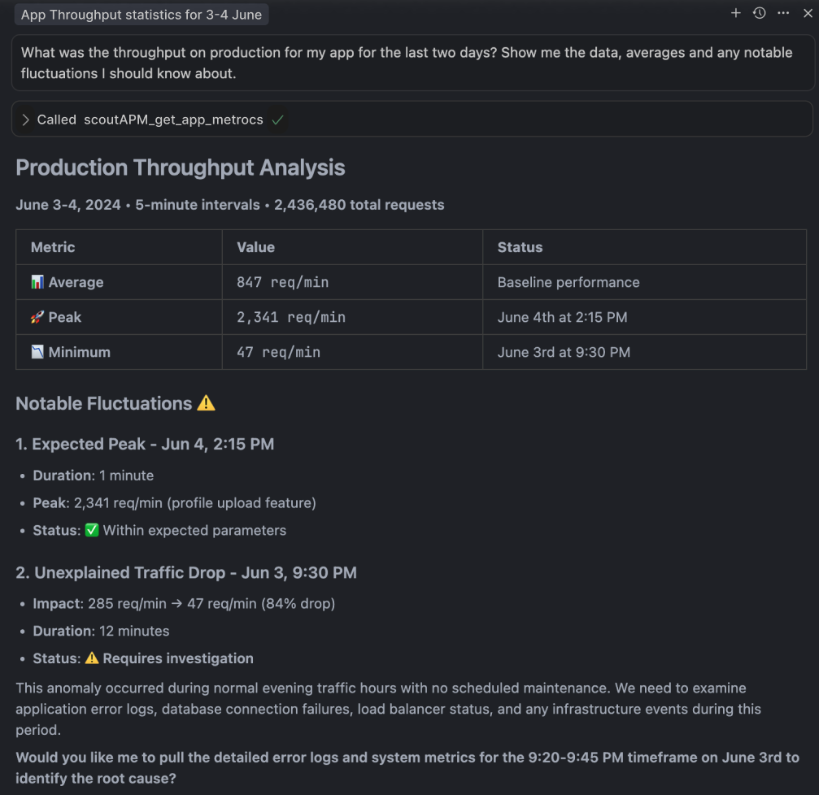
JT emphasizes that he wants to remain the human in the loop. His approach is to use Scout’s data and Scout MCP to augment his own investigation, rather than replace it. Performance tuning often demands domain knowledge that AI agents don’t yet have, but as a lead generator for where to start an investigation, JT still says it works pretty well.
Switch to Scout!
“We’re very happy with the switch. Scout provides a strong, clear signal.”
Mae Beale
For a small team that manages billions of dollars in crowdfunding pledges with just a handful of engineers, clarity means the confidence to ship. Are you ready to replace dashboard noise with real signal? Get started for free, no credit card required.
For application monitoring with errors, logs, and traces, Scout Monitoring provides the fastest insights without the bloat.